Cost guides
WMS pricing models explained, and the question that tests each one

Two WMS quotes can look the same on page one and behave nothing alike a year later. The difference is the pricing model: the thing the vendor measures to decide what you pay. Understand the measure, and you can predict how your bill will move.
This guide goes through the common models. It gives no prices. It gives you the question that tests each model, and a worksheet to line the quotes up.
What is being measured?
Every model picks something to count. When you read a quote, find the sentence that says what is counted, and write it at the top of your notes. If you cannot find it, ask. A quote that does not say what it counts cannot be compared.
The common models
Per user
You pay for each person who logs in, or for each seat reserved. Warehouses with a few office staff and a handful of shift leads can find this predictable. Warehouses with many pickers and temporary staff can find it climbs quickly.
The test question: "Do shared handheld logins count as users, and what happens during a seasonal peak when I add temporary workers?"
Per site or per warehouse
One price per building, sometimes with limits attached. It is easy to understand. It can feel steep for a very small second location, and generous for a large building.
The test question: "What exactly is included in one site, and what counts as a second site if I rent an overflow space for two months?"
Per order, per shipment or per transaction
The bill follows your activity. A quiet month costs less, and a busy month costs more. This can match cash flow, but it also means growth in volume directly raises the software bill.
The test question: "What counts as one transaction? Is a receipt line, a pick line, a move or a label one event or four?"
Tiers
You buy a bundle sized for a range, such as a band of order volume or number of users. The cost steps up when you cross a line.
The test question: "Where are the step points, and what is the price right after the one I am nearest to?"
Per client account (3PLs)
A price tied to how many client accounts you run. It can seem fair, but it may discourage taking on many small clients.
The test question: "If I onboard a client who ships a handful of orders a month, does that client cost me the same as one who ships thousands?"
Per asset, such as per truck or per dock
Common where the software also handles transport or yard activity. The cost follows fleet or dock count.
The test question: "What happens to the price when I lease three extra trailers for a season?"
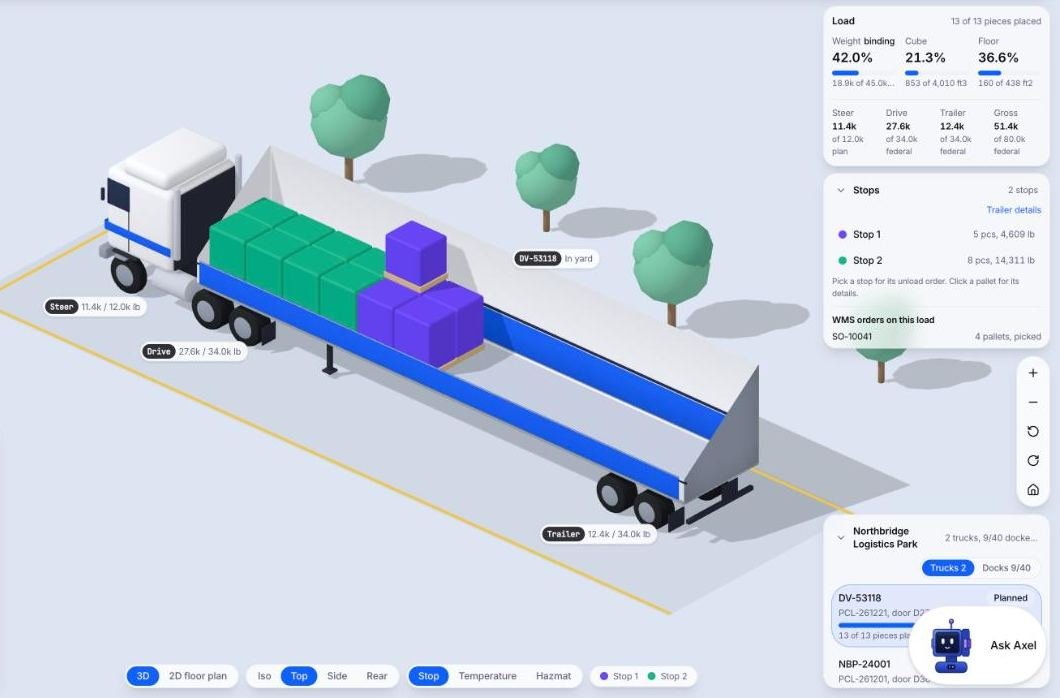
Some pricing follows assets such as trucks or docks. This screen from the Microsive demo platform, with demo data, is the sort of trailer view that makes the question concrete, so ask what happens to the price when your fleet or dock count changes.
Perpetual licence plus maintenance
You pay up front for the right to run the software, then a yearly fee for updates and support. The first payment is large, and the yearly amount is easy to overlook.
The test question: "What does the yearly fee cover, what is it based on, and what happens to the licence if I stop paying it?"
One-time custom build
A system made to your specification for a quoted build price. Cargohold, which we make, is a one-time custom build, no per-seat, per-truck or per-client fees. Support and changes after launch are separate lines, and they belong in your comparison.
The test question: "What do I receive when the build is finished, who owns the code and data, and how are later changes quoted?"
Models are not good or bad
A per-order model suits a seasonal business that wants costs to track revenue. A flat model suits a business that hates variable bills. A licence suits a buyer with capital and a long horizon. The right question is not which model is cheapest in the abstract, but which behaves best on your growth path.
The worksheet
Fill in your own numbers from written quotes. The letters below stand for amounts you replace. We do not supply values.
Step 1. Write the measure for each quote.
Step 2. Write today's quantity of that measure (for example, users today).
Step 3. Write what the quantity will be in a year and in three years, based on your own plan.
Step 4. Ask each vendor, in writing, for the total at each of the three quantities.
| Line | Quote 1 | Quote 2 | Quote 3 |
|---|---|---|---|
| What is counted | |||
| Recurring cost today (A) | |||
| Recurring cost in one year (B) | |||
| Recurring cost in three years (C) | |||
| One-off cost: setup, data load, training (D) | |||
| Integrations, if charged separately (E) | |||
| Three-year total (D + E + A + B + C, approximately) |
The three-year formula is a rough way to line up quotes, not an accounting method. If a quote has a price change built in, such as a yearly uplift, add it. Ask each vendor whether the price is fixed for a stated term.
A made-up example of the trap
This is a hypothetical, not a real quote. A warehouse is choosing between a per-user plan and a per-order plan. Today it has few users and moderate volume, and the per-user plan looks cheaper. Its plan is to double staff but keep volume steady. After filling the worksheet, the per-user plan climbs and the per-order plan stays flat. A quote that wins today loses at year three. The worksheet exists to show that before you sign.
Hidden multipliers to ask about
- Add-on modules. Is anything you need, such as billing or a client portal, extra?
- Environments. Is a test environment included?
- Data limits. Are there caps on storage of records or API calls?
- Support level. Does the quoted price include the support hours you need?
- Annual uplifts. Is there a built-in increase?
- Currency and tax. Are quotes in the same terms?
Questions to ask every vendor
- What is counted in your price, in one sentence?
- Show me the total at today's quantity, in one year and in three, in writing.
- What is included and what is extra?
- How long is the price fixed?
- What do I keep if I leave?
How to use this with the main cost guide
Our guide on what a WMS costs lists the cost buckets: subscription, implementation, integrations, training, change requests and hardware. This page sits one level below the first bucket. Use that guide to make sure every bucket is quoted, and this one to understand how the first bucket will behave as you grow.
Questions people ask
What are the common WMS pricing models?
Per user, per site, per order or transaction, tiers, per client account, per asset such as a truck or dock, perpetual licence plus maintenance, and a one-time custom build.
Which WMS pricing model is cheapest?
None is cheapest in the abstract. The right one is the model that behaves best on your own growth path, so test each against your plan.
How do I compare WMS quotes that price differently?
Write down what each quote counts and your quantity today, in one year and in three years. Ask each vendor for the total at each quantity and line the answers up in a worksheet.
What hidden costs should I ask about?
Add-on modules, test environments, data limits, the support level included, built-in annual uplifts, and whether quotes use the same currency and tax terms.
What should I ask every WMS vendor about pricing?
Ask what is counted in one sentence, the total at today's, next year's and three-year quantities, what is included and what is extra, how long the price is fixed, and what you keep if you leave.
Sources
- No third-party prices or vendor claims are used on this page. All figures in the worksheet are letters for you to replace with your own written quotes.